From charm to bottom
In the Godfrey–Isgur model the interaction is flavor-blind: confinement, the running coupling and the smearing parameters do not depend on the quark. A quark mass is therefore a free dial. This tutorial turns it from the charm to the bottom mass and watches heavy-quark physics appear: the hyperfine splitting falls like
using GIModel
using CairoMakie
params, mq = load_parameters_and_quark_masses(default_parameters_path())
S_levels = spectrum_levels(1; L_labels = ("S",))
A heavy quark with a free mass
HeavyQuark takes any mass. A meson built from quark objects needs no mass table:
Q(m) = HeavyQuark{:up}(m, :Q)
light = LightQuark(mq["q"])
Meson(Q(2.5), light)
Meson: Q qbar (m1 = 2.5, m2 = 0.22 GeV, reduced = 0.2022 GeV)For each heavy mass we compute the ground-state pseudoscalar and vector of the heavy-light system
masses = range(1.2, 5.4; length = 15)
function ground_states(meson)
    spec = compute_spectrum(params, meson; levels = S_levels)
    (P = spectrum_state(spec, "1^1S_0").mass_GeV, V = spectrum_state(spec, "1^3S_1").mass_GeV)
end
heavy_light = [ground_states(Meson(Q(m), light)) for m in masses]
quarkonium = [ground_states(Meson(Q(m), Q(m))) for m in masses]
The fast finite-difference default is enough here: we are after trends, and Solvers and convergence showed it agrees with the oscillator solver to well below an MeV.
The hyperfine splitting
The contact interaction is proportional to
fig = Figure(size = (700, 300))
ax1 = Axis(fig[1, 1]; xlabel = "m_Q  [GeV]", ylabel = "M(V) − M(P)  [MeV]")
ax2 = Axis(fig[1, 2]; xlabel = "m_Q  [GeV]", ylabel = "m_Q (M(V) − M(P))  [GeV²]")
for (states, name) in ((heavy_light, "Q q̄"), (quarkonium, "Q Q̄"))
    splitting = [s.V - s.P for s in states]
    lines!(ax1, masses, 1000 .* splitting; label = name)
    lines!(ax2, masses, masses .* splitting; label = name)
end
vlines!(ax1, [mq["c"], mq["b"]]; color = :gray, linestyle = :dash)
axislegend(ax1)
fig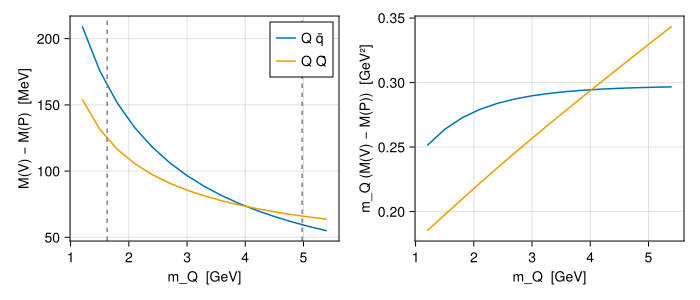
The dashed lines mark the charm and bottom masses. For
The binding energy of a heavy-light meson
In the heavy-quark limit, the light degrees of freedom do not care about
Λ̄ = [(s.P + 3s.V) / 4 - m for (s, m) in zip(heavy_light, masses)]
fig = Figure(size = (450, 300))
ax = Axis(fig[1, 1]; xlabel = "m_Q  [GeV]", ylabel = "M̄ − m_Q  [GeV]")
lines!(ax, masses, Λ̄)
fig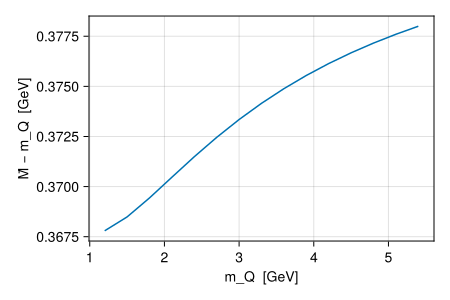
stays close to 0.37 GeV over the whole range, changing by less than 10 MeV between the charm and bottom masses: the light degrees of freedom are nearly the same in
Why the medium does not need retuning
Changing the heavy mass leaves light mesons untouched, because the interaction parameters are shared by all flavors and only the constituent masses of each meson enter:
rho(p) = spectrum_state(compute_spectrum(p, Meson(mq, :u, :d); levels = S_levels), "1^3S_1").mass_GeV
rho(params)0.7711896047422471This mass does not depend on anything we varied above. By contrast, changing the interaction, for example the string tension, moves every meson:
steeper = GIParameters(params; potential = ConfinementPotential(params.potential; b = 0.20))
rho(steeper)0.8230167453045851This separation is what makes the Godfrey–Isgur model predictive: one set of interaction parameters for all flavors, and quark masses as the only flavor-dependent inputs.